, ,

Pass-2-Load Version 3.3 Release Jan 2019

Safe Load Program Operating Guideline 7 Version 3.3 will be released in Jan 2019, the update will include a number of changes to align with changes in the Australian Dangerous Goods Code (ADGC) and the requirement to meet legislation introduced by the New South Wales Government for tanker trailer roll stability.

Changes Include:
• API outlet cap retaining options, cables and chains. (Performance Improvement)
• Emergency Information Panel (EIP) access and legibility (ADGC)
• Emergency Procedure Guide (EPG) holder location (ADGC)
• Eyewash kit location (ADGC)
• Cabin fire extinguisher location (ADGC)
• Internal compartment inspection (Quality Improvement)
• NSW roll stability 1st Jan 2019 (EPA Determinations)
• Pass-2-Load labels and inspection (the update will mirror previous end of month expiry and colour changes)
• SLP participant responsibilities (COR outlining roles)
• Torch location (ADGC)
• Vehicle registration (COR outlining responsibilities)
• Vapour hose stowage (Australian Standard 5602-2009)

AIL Pass-2-Load Inspection have been updated to reflect the changes required from the 1st of Jan 2019.

OG7-V3.3-Flyer
2019 OG7 Updates
Operating Guideline 7-Version 3.3 (OG7V3.3)
SLP OG7-V3.3 Amendment table-Dec2018
2019 Roll Stability SLP Owner/Operator and AIL Guidance Document
Version 3.3 Pass-2-Load Checklists
Links:
Presentation – Identifying RSS and DGTVIM
EPA RSS Driver Flyer A4
EPA Determinations
Dangerous Goods Tank Vehicle Inspection Manual

, ,

New Look to Vehicle Inspection Information

SLP has made some small changes to the look of the vehicle details summary TAB to make it a little easer to see when a vehicle’s inspections are within date or out of date?

The right hand side of the vehicle summary screen will turn Green when the necessary inspections are within date, and the screen turns Red when a required inspection/s are not in date.

Entering vehicle Roadworthy information is still not a minimum requirement and will not affect the overall compliance in the SLP system.

On the left hand side of the screen;

When the vehicle owner has answered all of the mandatory details questions correctly this will show up in the vehicle Tier in a blue box [Registered for Inspection]

If the minimum requirements for SLP have not been met or entered then the Tier will show in a grey box [Check Mandatory Features]

Vehicle owners must ensure that Hydrostatic Testing and Hatch & Vent Testing inspection dates for their tankers and Rigid vehicles are entered correctly. This information can be found in the last Pass-2-Load Inspection documents that have been entered in the system by the Inspection location.

For more Information and assistance Please contact us at SLP

Lee Stringer

SLP Manager

, ,

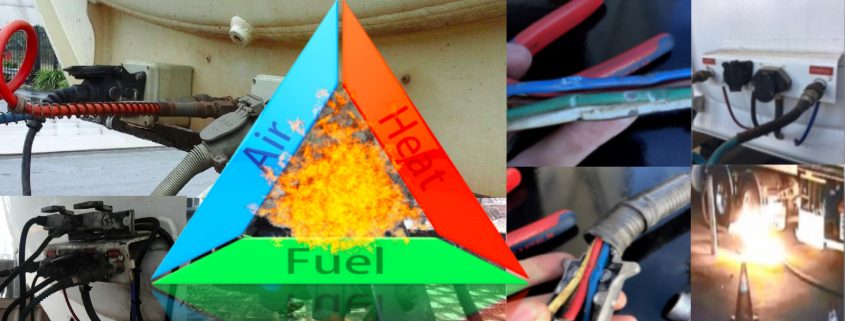
Trailer electrical plug maintenance leads to fire

In a recent early morning fuel delivery, being dark the driver turned on the tanker work light and connected a transfer hose to the customer diesel tank delivery point. The driver then proceeded to connect the other end of the transfer hose to the tanker.  It was at this point that a spark occurred jumping between the open end of the transfer hose and tanker connection point.

The spark most likely ignited vapour from petroleum residue left in the transfer hose from a previous delivery, the vapours emanating from the open end of the transfer hose.

The tanker combination was later inspected by an auto electrician for faults, while replicating the fault the auto
electrician discovered that a newly fitted stainless steel male trailer plug and its centre retaining clip had pinched the work light power cable, exposing the inner wire, allowing power to travel through the body of the male plug into the female plug body and on to through to the tanker, thus making the tanker structure live!

Please read the attached flyer for more details and the learnings.

SLP flyer (Trailer Plug Incident)

Regards
SLP Manger
Lee Stringer

,

Return To Service Documents Protect Drivers & AIL’s

In a recent incident a driver attempted to load a tanker at an SLP terminal before the tanker had not been released for loading by a repairer. The incident has learnings for drivers and repairers, in this case the repairer was an SLP Authorised Inspection Location.

The key point for a driver in this incident was that the tanker was clearly not in a normal condition, (a compartment outlet pipe and API valve had been removed from the tanker)
If the tanker does not look normal or a driver suspects the tanker condition has changed the driver must request a return to service document be provided so the driver can assess if the tanker has been made fit to put back into service.

The repairer must ensure they do one of 2 things, either put the tanker into a safe condition where it can be put back in service and supply the tanker operator with a return to service document confirming the tanker is safe to use, or ensure the tanker operator is made fully aware the tanker is not fit for service.
The repairer can fit a lock out tag indicating the tanker out service or tape a notice on the tanker barrel advising the vehicle is not fit for service. The lock out or tag out can be placed on the drive away protection system gate.

-DRIVERS if the tanker does not look like it normally does or you know its returning from repairs or service you must insist on a return to service document!
-REPAIRERS (AIL’S) if the tanker is not ready for use, lock the tanker out of service via a lock out or tag out system.
-REPAIRERS (AIL’s) if the tanker is fit for service provide the operator with access to a completed return to service document.

Incident Flyer

Lee Stringer
SLP Manager
[email protected]
0419908919

,

Are your OverFill Protection probes fail safe?

A Civacon overfill protection probe recently failed to shut down a fuel terminal loading gantry when the compartment was overloaded due to human error. The probe was similar to probes that had been previously subject to
an Australia wide industry recall in 2012, the probes distributed by Treloar Group Pty Limited.

Authorised Inspection Locations:

  • do you suspect any of your customers are still using glass tipped Civacon probes?
  • have you spoken to your customers about the risk of using these glass tipped Civacon probes?
  • do you pay extra attention to tankers with a built date of before March 2012? (as they may be fitted with glass tipped Civacon probes)
  • do you pay extra attention to vehicles fitted with Treloar hatches or hatch equipment? ( as they may be fitted with glass tipped Civacon probes)

Tanker Owner:

  • do you suspect any of your tankers are still using glass tipped Civacon probes?
  • have you spoken to your maintenance provider about the risk of using these glass tipped Civacon probes?
  • was any of your tankers built before March 2012? (as they may be fitted with glass tipped Civacon probes)
  • is any of your tankers fitted with Treloar hatches or hatch equipment? (as they may be fitted with glass tipped Civacon probes)

If your driver makes a mistake and overloads a compartment on his/her tanker and the overfill protection probe fails to shut down the loading system, the potential for a catastrophic event including loss of life is extremely high, protect your drivers and your assets by ensuring you are not still operating equipment fitted with glass tipped Civacon probes.


PROBE ALERT FLYER

Regards
All enquires, please contact:

Lee Stringer
SLP Manager [email protected]

,

Pass-2-Load Updates

Pass-2-Load inspection expiry date and label colour changes.

What has changed?

  • SLP has changed the way expiry dates are applied under the Vehicle Compliance Program.
  • Pass-2-Load, Hatch & Vent and Hydrostatic test expiry dates are now automatically extended to the end of month.
  • No matter what date the inspection is completed, expiry date will be extended to end of month.
  • Commencing 1st of November 2017 the need for SLP Pass-2-Load inspection labels to be coloured either Yellow or Blue according to the period the label expires will cease.
  • Once all SLP’s current stocks of Blue labels are sold, SLP will issue “Yellow” labels only.

 Why change?

  • SLP has made this change to allow transport operators the ability to better manage and align their vehicle maintenance and inspection requirements allowing for product hose, extinguisher and vehicle servicing to be aligned with a Pass-2-Load, Hatch & Vent and Hydrostatic test inspection.
  • With the introduction of the SLP electronic vehicle inspection system (VCP) and our increased independent inspection program the need to change Label colours in line with the expiry is not required.
  • How the program is used and monitored has significantly change from the original creation of the Pass-2-Load  scheme, and this is just further streamlining the way the inspection program is managed.
  • In a recent review we found that at high number of SLP users either had no awareness of why we used the coloured labels, or were not using the label colour as a means of identifying if the vehicle was expired. While many others simply found the colour system process was confusing.

Vehicle Compliance Program System expiry date change

  • The VCP IT system will automatically set the Pass-2-Load expiry date to 6 months plus the required number of days to end of month. A note is displayed in the system advising of this when the inspection is being entered. The same applies to Hatch & Vent 2 ½ yearly and 5 yearly Hydrostatic tests.
  • Note:

(The expiry date will be set to the end of the month regardless of the date selected)

  • The system will allow for expiry dates to be manually changed in the system to any date under end of month allowing users to manually select a date less than six months end of month due to a Standard or legislated compliance date that needs to be complied with.
  • If you are experiencing any problems with the system or a vehicle expiry date please contact us at SLP and we will work with you to rectify the problem.

Benefits label colour change

  • In the future SLP Inspection locations will only need to keep the one coloured label in stock.
  • The change will remove confusion over the way the labels are issued and monitored.

FAQ’s for label colour change

  • I’m an AIL and currently have a large number of blue labels in stock can I still use them?
    • From 1st this month both yellow and blue labels are acceptable to fit to customer vehicles.
  • I’m an AIL and have blue labels in stock, can I fit them on customer vehicles now?
    • Yes you can attach either a yellow or blue label to a customer vehicle from 1st of Nov 2017.
  • What colour labels will SLP be supplying in the future?
    • In the future SLP will only supply a Yellow Pass-2-Load Label, in the short term SLP will quit its stocks of blue labels, so some customers may be issued with a mix of blue and yellow as we clear our current stocks.
  • How will I know what month the Pass-2-Load Label on a vehicle expires if I cant use the label colour as a guide?
    • You can view the expiry date written on the label, or go online to SLP-VCP website and type in the vehicle registration and confirm the vehicle Pass-2-Load expiry date.
  • Do I need to do anything different when ordering Pass-2-Load Labels?
    • AIL users will have access to a new purchasing link found in the Vehicle compliance Program Portal, this can be found under the “Documentation” Tab on your home screen. Note the old purchasing system will remain in place until the end of the year and can still be used to purchase labels.
  • Will the SLP OG7 be updated to reflect the changes?
    • Yes an updated version of the SLP Operating Guide 7 will be released in Jan 2018 with all the latest changes included.

For all queries, please contact:  Lee Stringer

SLP Manager  1300 921 713   –  option 3

[email protected]

Flyer Expiry Date Change

Flyer Label Colour Change


,

Pre 2005 Probe Sensor Alert

Is your tanker fitted with pre 2005 Glass Overfill Protection System probes?

SLP ALERT

Recently a product spill occurred at a terminal when a driver incorrectly connected a loading arm to a compartment that he had already loaded. Failing to recognise the mistake the driver started the loading system and product started entering the compartment, under normal conditions once product has reached or exceeded the compartment Safe Fill Level the Overfill Protection System probe would come into contact with the product and it would activate the Overfill Protection System shutting down the loading system, closing the product flow valves and stoping the loading pumps.
In this case the probe did not detect the overfill and did not shut down the loading system. The driver noticed product flowing from the the top of the tanker and he activated the gantry emergency stop, stopping product flow, the driver then raised the alarm.
Why did this happen?
The compartment was fitted with an Overfill Protection System probe manufactured in July 2004 this probe comes fitted with a heat shrink material that surrounds and protects the glass body of the Overfill Protection System probe. The heat shrink material on this particular probe, over time appears to have dislodged from its original position and has slid down the body of the probe creating a void / shroud at the base of the probe.
During the overfill incident this void/shroud has created an air pocket preventing the rising product in the compartment from reaching the sensor at the base of the probe. This void simply prevented the probe from detecting the product and thus prevented the Overfill Protection System from shutting down the product flow causing the product spill.
Details:
  • The probe was manufactured in July 2004
  • The heat shrink surrounding the body of the probe has repositioned to a location lower than specified within the probe design.
  • Impression markings on the heat shrink indicate the heat shrink was originally located in the correct position.
  • The heat shrink is tight and cannot be moved by hand
  • The probe powers up correctly
  • The probe provides a normal signal
  • The manufacture and industry has no previous record of the heat shrink material dislodging in this way.
  • Testing shows the air trapped within the dislodged heat shrink material prevents fluid from contacting the probe activating prism.
  • The manufacture fitted heat shrink material to all pre 2015 models of this probe

SLP Recommends

Tanker Owners

  • If you know or suspect your tanker is fitted with these heat shrink covered glass type probes!
    We recommend that you have these probes inspected immediately: by removing the probe from the probe holder and inspecting the heat shrink material to ensure the material has not dislodged. If you suspect the heat shrink has dislodged then please contact the probe manufacture for further advice before reinstalling the probe.
  • If your not sure if your tanker is fitted with these heat shrink covered glass type probes?
    We recommend all probes are checked when the tanker receives its next 2 ½ yearly hatch & vent or 5 yearly hydrostatic inspection, by removing the probe from the probe holder and inspecting the heat shrink material to ensure the material has not dislodged. If you suspect the heat shrink has dislodged then please contact the probe manufacture for further advice before reinstalling the probe.
  • Best Practice: SLP recommends these heat shrink encapsulated glass type probes be replaced, or the heat shrink material be removed from the probe before its returned to service, in doing this we again recommend you contact the manufacture for advice.

SLP Authorised Inspection Locations

  • When your inspector is completing the probe wet test section of an SLP Pass-2-Load inspection;
    • we recommend as much as is physically possible the inspector try to visually determine the type of probe installed in the tanker compartment,
    • if you suspect the compartment is fitted with a glass type probe, the probe must be removed and inspected for any fault or movement in the heat shrink material;
    • if the heat shrink material has dislodged contact the probe manufacture for further advice.
  • When inspecting tankers for a 2 ½ yearly hatch & vent or 5 yearly hydro inspection;
    • all probes must be removed and inspected for compliance and or physical damage.

Terminals

  • We know this type of probe is still in service, but we also believe the number in use is low.
  • During your normal inspections at a terminal, If you discover a tanker is fitted with heat shrink coated glass probes, we suggest you request the tanker owner provide evidence that they have had the probes inspected.


probe01

IMG_0838


IMG_0840


IMG_0837


SLP Manager

Lee Stringer [email protected]
0419908919

,

EIP Update

EPI (Emergency Information Panel) Mounting Information.
Terminal and Inspection locations have requested clarification on access requirements to EIP’s mounted at the rear of B-Double lead trailers.

Lessons learned
• The rear of B-Double lead trailers is often a difficult if not impossible location to mount an EIP that can be easily accessed from ground level.
• Tanker manufactures and vehicle owners should ensure EIP signs that are regularly switched can be accessed by a driver while standing at ground level to increase driver safety and lower the risk of slips or falls.
• The exception to this rule is any EIP located at the rear of a B-Double lead tanker, the mounting options available for EIP’s where they can be easily accessed from the ground is often rare.
• Signs located at the rear of B-Double lead trailers are rarely used unless the tanker combination is split and the lead tanker is operated as a single trailer unit.
• The risk of injury is lower for these signs based on the signs infrequent use.
• The need to provide a safe means of access to any EIP sign that is not easily accessible from the ground is an important part of reducing driver slips and falls.
Please read more: SLP EIP Update flyer

Regards

SLP Management

,

Watch Out!

Terminal operators across the country have placed smart watches and fitness monitoring bands into the same high risk category as other portable electronic devices, banning the wearing or use of these devices to fuel terminals and loading gantries.

If you’re wearing a smart watch or fitness band please confirm with fuel terminal staff that the device you’re wearing is approved for use in their terminal.

Digital wrist watches are not typically considered a safety risk unless they contain the features of a smart watch e.g. Bluetooth, WIFI, etc.

Smart watches and fitness monitoring bands can be equipped with features like; Bluetooth, WIFI, SMS and in some cases, can operate as a phone c/w a phone sim card and mobile network access, receiving phone calls, SMS messages and notifications. It’s difficult for terminal operators to assess these differing devices and ever changing specifications for their safe use and compliance with safety standards.

So many terminals across the country have taken the option to  ban the use of all smart watches and fitness monitoring bands or straps.

These devices can be a distraction while loading a vehicle in a terminal and some devices are fitted with very high powered large capacity lithium batteries that do not comply with the regulations for use within a zone 1 atmosphere.

For further queries, please contact:

Lee Stringer

SLP Manager

[email protected]

Seen the (daytime) light?

DAY TIME DRIVING LIGHTS

Over the past 5 years daytime driving lights are becoming more and more prevalent in heavy vehicle design as are many other design innovations. Many European vehicles fitted with day time driving lights are also fitted with a system known as a “CAN” based electrical system, basically the vehicle is fitted with a common wiring system connected to several devices at once for example the vehicle headlights, driving lights, brake lights, windscreen wipers and indicators may all be connected by one set of electrical wires, and when they turn on or off is governed by the vehicles computer.

This type of technology can make it extremely difficult to isolate a particular device like driving lights that are designed to be on at all times and only deactivated by the vehicle ignition being turned off, trying to fit an aftermarket switch that turns off the driving lights could also isolate power to many other devices on a common electrical feed. This could also cause problems with the vehicles on board computer.

SLP has made the decision to add daytime driving lights to the list of items to be exempt from “being isolated before entering a gantry” the current list of exempt items includes other safety related devices, like Windscreen wipers, brake lights, indicator lights, horn, electric windows, cabin step lighting, cabin fan (defrosting windscreen), interior lighting, ABS – EBS wheel sensors, etc.  All these items are considered to be extremely low risk in the task of driving a vehicle into a fuel loading gantry.

The rules still remain in place that once the vehicle enters the gantry the driver is to stop the vehicle, apply the parking brake and turn the vehicle ignition to the off position; in doing this many of  the above items will be isolated including driving lights. Other items like interior light and cab step lighting are only active for short periods of time while the vehicle door is open when the driver is exiting the vehicle.

Under the current load training program drivers are made aware they are not to open the vehicle cabin doors while the vehicle is loading.

The risk posed by daytime driving lights and headlights permanently wired to be on during the day must be kept in perspective, the greatest risk posed by electrical components is posed during loading, not while the vehicle entering or exiting the gantry.

The risk has been assessed across the industry and the risk posed by driving lights is seen as extremely low in comparison to other electrical risks like a vehicle starter motor and its relays while cranking under the high loads at engine start up.

If you require further information please contact

SLP manager

Lee Stringer [email protected]

0419 908 919